
Snowdrop: January's First Sign of Spring
One of the two flowers associated with January, alongside the carnation, the snowdrop has become a natural emblem of hope, perseverance, reassurance, and beginnings that happen quietly. It does not wait for perfect conditions. It emerges while the season is still changing.
For someone born in January, that makes the snowdrop an especially thoughtful birth flower: modest in appearance, surprisingly hardy, and closely connected with the feeling that something new is already on its way.
AT A GLANCE
Love, admiration, devotion.
A cherished flower for celebrating life's special moments.
Why Can Snowdrops Flower in the Cold?
Snowdrops grow from bulbs, which act as storage systems. Energy gathered during the previous growing cycle is held below the soil until conditions allow the plant to begin emerging again.
This gives snowdrops an important head start.
They do not need to build all their energy from scratch at the beginning of the season. Stored reserves help fuel early growth, allowing them to flower before many neighboring plants become active.
Their schedule also gives them access to something that will become harder to find later: light.
In woodland environments, deciduous trees are still bare when snowdrops emerge. Sunlight can reach the ground before the tree canopy fills with leaves. Snowdrops use this brief seasonal window to grow, flower, and begin replenishing their bulbs.
Guide to the Snowdrop
A Snowdrop Is More Detailed Than It First Appears
From a distance, a group of snowdrops can look like scattered white drops beneath trees.
Up close, the flower has a surprisingly precise structure.
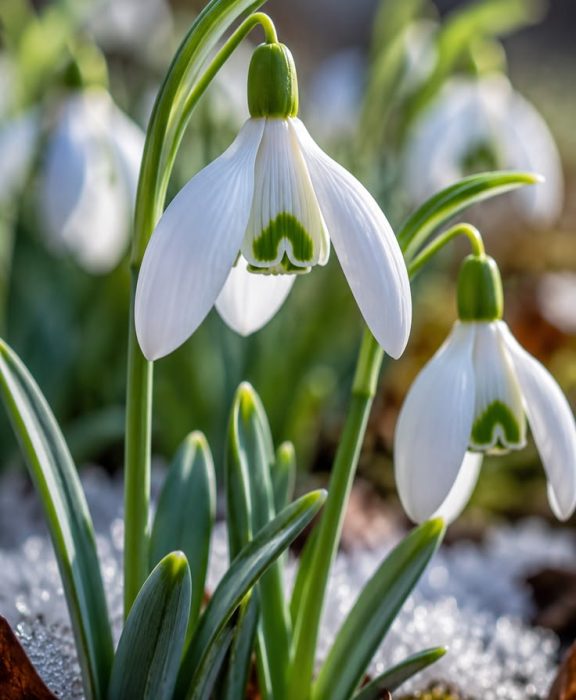
A slender stem usually carries a single downward-facing bloom. Three longer white outer segments surround three shorter inner ones, which often carry distinctive green markings. The flower hangs rather than faces upward, creating the characteristic nodding shape.
Below the bloom, narrow green to blue-green leaves rise from the bulb. Most snowdrops remain relatively low to the ground, commonly reaching around 4 to 10 inches (10 to 25 cm) depending on the species, variety, and growing conditions.

Snowdrops in Folklore: A Flower With Two Sides
Snowdrops have not always carried one simple, universally positive meaning.
In many places, their early appearance made them welcome signs of seasonal renewal. Seeing the first snowdrops could mean the darkest part of winter was passing. Yet older folklore could be more complicated.
Some traditions connected snowdrops with misfortune or discouraged bringing them indoors. Beliefs varied considerably by place and period, and they should not be treated as a single universal interpretation of the flower. That contrast is revealing.
Flowers that appear at seasonal thresholds, between winter and spring, dormancy and growth, often gather contradictory stories. The snowdrop could be seen as hopeful because it marked the return of life, while its pale color and winter setting allowed other associations to develop elsewhere. Today, most people encounter snowdrops in a much simpler way: as one of the first pleasures of the gardening year.
Thinking of Growing Snowdrops? Choose the Site First.
Let the Leaves Finish Their Job
After flowering, the foliage may begin to look less tidy. Resist the urge to remove it immediately.
The leaves are still helping the plant gather and store energy for the next growing cycle. Allow them to fade naturally before cutting them back.
Expect a Slow Transformation
A few snowdrops do not become a woodland carpet overnight.
Given suitable conditions, established plants can gradually form larger clumps and spread. The pleasure is in watching the display develop over several seasons.
The Winter Tradition of Going to See Snowdrops
Some flowers are primarily enjoyed in bouquets. Snowdrops are often best experienced where they grow.
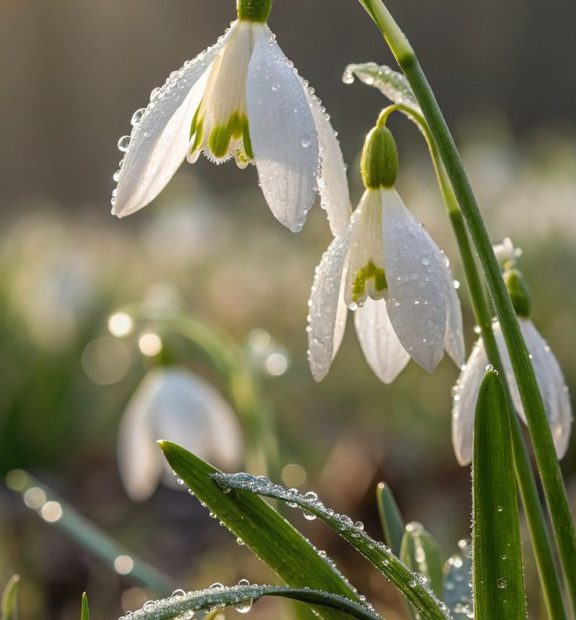
In parts of Europe, particularly the United Kingdom, gardens and estates are known for seasonal displays in which large colonies of snowdrops spread beneath bare trees. Winter walks are planned around the flowering period, giving visitors a reason to explore gardens at a time of year often considered off-season.
The experience is very different from viewing a single cut bloom.
A naturalized drift shows what snowdrops do best: repeat. Hundreds of small white flowers turn a quiet woodland floor into a seasonal event without losing the understated character of the individual plant.
This makes the snowdrop unusual among birth flowers. Its appeal is not necessarily about building the biggest bouquet. Sometimes, the better gift is the experience of seeing it bloom.
What Makes the Snowdrop a Particularly Fitting January Flower?
January sits between two ideas.
It is the beginning of a new calendar year, yet in many climates it is also one of the coldest, quietest periods. The excitement of a fresh start exists alongside winter’s slower pace. The snowdrop fits that contradiction perfectly.
It is a flower of beginnings that does not pretend everything has already changed. It blooms while winter is still present. It suggests progress without spectacle and strength without hardness.
For a January birthday, that can make its message feel especially personal: You do not have to wait for perfect conditions to begin.
All 24 Blooms
Explore More Birth Flowers
FAQ
Frequently Asked Questions About the Snowdrop Birth Flower
Yes. The snowdrop is traditionally recognized as one of January's two birth flowers. The other is the carnation.
Snowdrops are commonly associated with hope, renewal, resilience, reassurance, and new beginnings. These meanings are strongly connected with their habit of flowering very early in the year.
Snowdrops grow from bulbs that store energy underground. These reserves help the plant begin growing early, while bare deciduous trees also allow more light to reach the ground.
Snowdrops are known for white flowers, usually with green markings on the inner floral segments. Different species and cultivated varieties show subtle variations in form, markings, size, and flowering time rather than a broad spectrum of flower colors.
Galanthus, the botanical genus name for snowdrops, comes from Greek roots commonly translated as "milk flower."